Transfer Station Info (Tip Fee $113.00/ton)
- Mt. Olive Mon-Fri 7:30am-3pm; Sat 7:30am-11am
- Parsippany Mon-Fri 7am-3pm; Sat 7:30am-11am
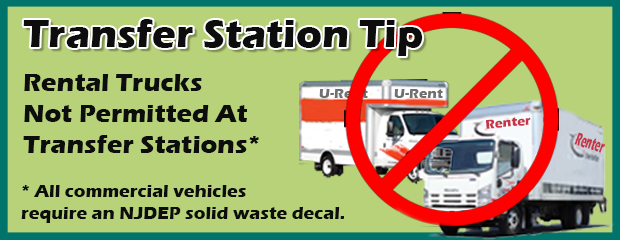
- No Rental Trucks
- Payment by Account, Check, Credit Card. No Cash
- Home
Morris County's
Environmental Resource
Welcome to the Morris County Municipal Utilities Authority's (MCMUA) website; MCMUA.com. The MCMUA Solid Waste Division implements recycling, solid and hazardous waste programs throughout Morris County. The MCMUA Water Division sells drinking water to several municipalities and water companies. The MCMUA is Morris County's environmental resource.
- Solid Waste
 Recycling
Coordinating and running recycling programs throughout Morris County. Garbage Disposal
Two transfer stations handle the disposal needs of Morris County. Collection Service
Residential, commercial and institutional recycling pickup Hazardous Waste
Managing household hazardous and eligible business waste. Compost Providing compost and mulch made from Morris County's vegetative waste
 Clean
Clean
Communities
Anti-Litter Programs Waste
Waste
Reduction Reuse Solid Waste
Planning Facility Inclusions Towns
Towns
Municipal Information - Water
 Water System
Wholesale drinking water provider.
Water System
Wholesale drinking water provider. Water Quality Keeping our water clean - Drinking water quality reports.
 Conservation Saving water because it is a valuable resource in so many ways.
 Education Resources to help learn about water and how to use it wisely.
 Open Space MCMUA working with Morris County to preserve open space
 - About the MCMUA
 Contacts
MCMUA board members, staff and more Directions
Maps, locations and directions to MCMUA facilities Public Disclosure
Information for the public we serve Current Legal Notices/Bids
Public Notices, Bids, RFPs, Quotes

Morris County
Municipal Utilties Authority
Transfer Station Info (Tip Fee $113.00/ton)
- Mt. Olive Mon-Fri 7:30am-3pm; Sat 7:30am-11am
- Parsippany Mon-Fri 7am-3pm; Sat 7:30am-11am
- No Rental Trucks
- Payment by Account, Check, Credit Card. No Cash
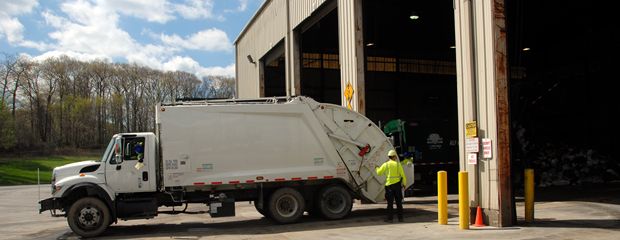
Transfer Station Disposal
In a March 26, 2026, certification of a Solid Waste Management Plan Amendment dated August 2025 NJDEP approved a modification to the Plan incorporating a 5-year transportation and disposal contract between the MCMUA and Solid Waste Services, Inc. d/b/a J.P. Mascaro and Sons. This contract was executed July 8, 2025 with work under the contract beginning December 15, 2025 continuing through December 14, 2030.
Who We Help and Serve
 Hauler
Using MCMUA transfer stations and other facilities...
 Residents
At home we recycle, create waste, and use water.
 Business
At work we recycle, create waste and use water.
Towns and Government
Working together for a better Morris County ...
Ultimate Disposal
This contract and associated Plan Amendment establish the ultimate disposal locations for Morris County's Waste Types 10, 13, 13C, 23, 25 and 27 solid waste. These disposal locations are as follows:
- Commonwealth Environmental Systems (CES) Landfill, Hegins, Pennsylvania
- Keystone Landfill, Dunmore, Pennsylvania
-
Pioneer Crossing Landfill, Exeter Township, Pennsylvania
The Keystone Landfill, located in Dunmore PA, receives virtually all of the waste disposed of through the MCMUA transfer
stations. Additional information about Keystone Landfill is provided.
Find It Fast
Keystone Sanitary Landfill
The Keystone Sanitary Landfill is a modern, state-of-the-art sanitary landfill located at 249 Dunham Drive in the boroughs of Dunmore and Throop, Lackawanna County, Pennsylvania. Situated approximately two hours west of Morris County and adjacent to Interstate 81, it serves as the primary long-term disposal site for virtually all of Morris County’s municipal solid waste (MSW).
General Facts
Spanning approximately 714 acres with a permitted disposal footprint of about 335 acres, Keystone is one of Pennsylvania’s largest and most advanced landfills. It is fully permitted and regulated by the Pennsylvania Department of Environmental Protection (DEP). The facility accepts primarily municipal solid waste from Pennsylvania, New Jersey, New York, and Connecticut, and operates under strict environmental standards. It has earned the prestigious ISO 14001 certification for its environmental management system, demonstrating a strong commitment to sustainability and regulatory compliance.
How a Sanitary Landfill Works
At a sanitary landfill like Keystone, waste is managed in a carefully engineered and controlled manner:
- Arrival and Placement: Trucks deliver waste to the working face (the active disposal area). The waste is spread in thin layers, compacted by heavy machinery to reduce volume, and covered daily with soil or an approved alternative material. This daily cover helps control odors, litter, and disease-carrying animals.
- Lined Disposal Cells: Waste is placed into specially designed “cells” built on top of protective liners. These liners prevent liquids from migrating into the ground.
- Leachate Management: Rainwater and liquids that percolate through the waste (called leachate) are collected through a network of pipes and pumped to an on-site treatment facility before safe discharge.
- Long-Term Closure: Once a section is full, it is capped with an impermeable cover system and monitored for decades to ensure continued environmental protection.
Environmental Protections
Keystone goes well beyond basic regulatory requirements to protect air, water, and surrounding communities:
- Groundwater Protection: Multiple layers of liners and a sophisticated leachate collection system keep potential contaminants from reaching groundwater.
- Landfill Gas Management: As organic waste decomposes, it produces landfill gas (primarily methane and carbon dioxide). Keystone’s comprehensive gas collection system captures over 90% of this gas. Instead of simply flaring it, the captured gas is processed at the on-site Assai Renewable Natural Gas (RNG) facility operated by Archaea Energy — one of the largest and highest-capacity RNG plants in the United States.
- Air Quality & Emissions Control: Advanced systems significantly reduce odors and air pollutants. The RNG project converts methane (a greenhouse gas 25 times more potent than carbon dioxide) into clean, pipeline-quality renewable natural gas, reducing over 200,000 metric tons of CO2-equivalent emissions each year.
- Continuous Monitoring: The facility is regularly inspected by the Pennsylvania DEP and employs real-time monitoring for air, water, and operational performance.
This combination of modern engineering, daily operational controls, and innovative renewable energy recovery makes Keystone a responsible and environmentally protective choice for Morris County’s solid waste disposal needs. It aligns with the MCMUA’s commitment to safe, sustainable waste management that protects public health and natural resources for current and future generations.
Advanced Environmental Protections and Landfill Gas Management
Keystone Sanitary Landfill employs state-of-the-art environmental controls, including a comprehensive landfill gas collection system. This system captures over 90% of the landfill gas generated by the anaerobic decomposition of organic waste. Landfill gas consists primarily of methane (CH4)—a greenhouse gas approximately 25 times more potent than carbon dioxide—along with carbon dioxide and trace compounds.
Rather than allowing methane to vent or simply flaring it, Keystone has partnered with Archaea Energy to implement the Assai Renewable Natural Gas (RNG) facility.
The Assai RNG Project – Leading the Way in Sustainability
The Assai facility is the highest-capacity operational RNG project in the United States, with an inlet capacity of 22,500 scfm. Operational since early 2022, it upgrades captured landfill gas into pipeline-quality Renewable Natural Gas. This RNG displaces fossil natural gas for uses such as vehicle fuel (CNG), heating, and power generation.
Key Environmental Benefits include:
- Expected annual reduction of over 200,000 metric tons of CO2 equivalent emissions
- Significant reduction in air pollutants, with many pollutants reduced by over 90%
- Conversion of a potent greenhouse gas into a valuable renewable energy resource
- Support for long-term climate change mitigation by capturing and beneficially using gases that would otherwise contribute to global warming
According to the U.S. EPA, reducing landfill emissions is one of the best ways to achieve a near-term beneficial impact on climate change.
Why Keystone Landfill Is a Wise Choice Over Municipal Incineration
Compared to combustion in municipal waste incinerators, the combination of controlled landfilling at Keystone with advanced gas capture and RNG production offers superior environmental performance in several key areas:
- Lower Air Pollutant Emissions: Avoids the high levels of nitrogen oxides, acid gases, and other combustion byproducts associated with incineration of mixed waste.
- Effective Greenhouse Gas Management: Captures and beneficially reuses methane, providing both emission reductions and carbon-negative attributes when RNG displaces fossil fuels.
- Sustainable Energy Recovery: Produces pipeline-quality renewable natural gas rather than one-time electricity generation with associated stack emissions.
- Regulatory Compliance and Long-Term Capacity: Keystone continues to expand responsibly under strict Pennsylvania DEP oversight, ensuring reliable disposal capacity aligned with Morris County's Solid Waste Management Plan.
Learn more about the Assai RNG project: Visit Archaea Energy